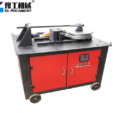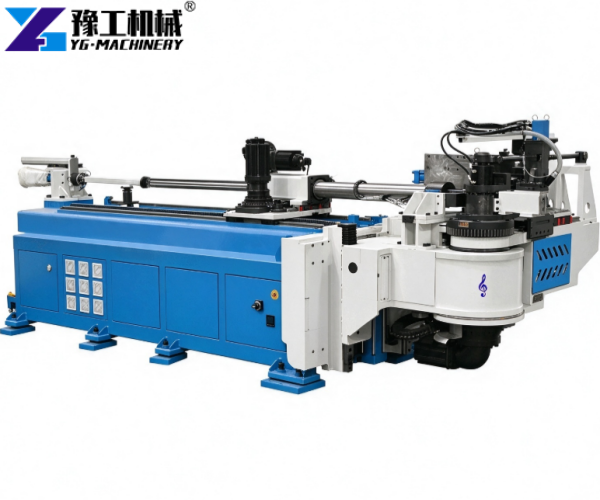
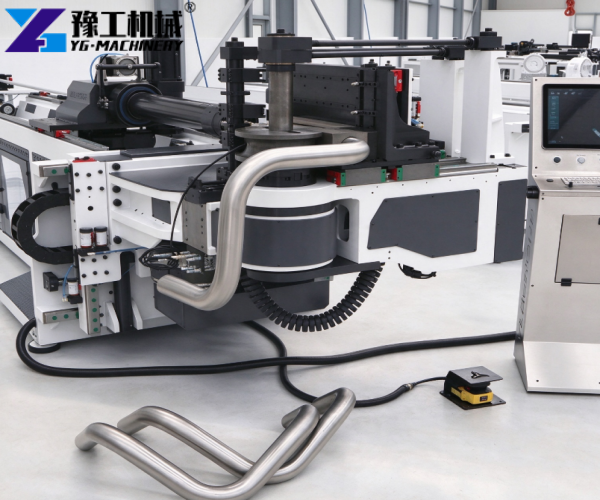
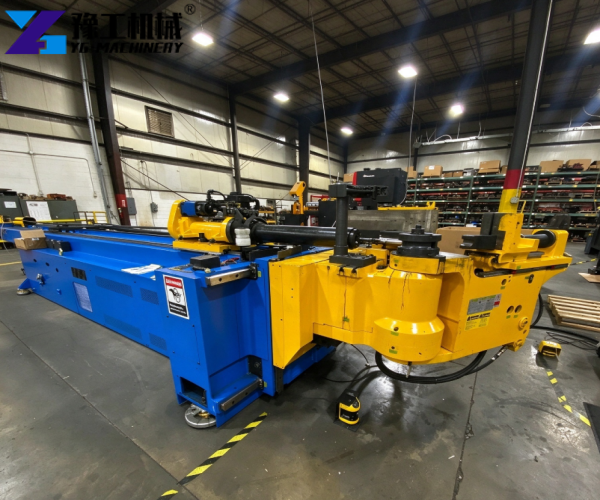
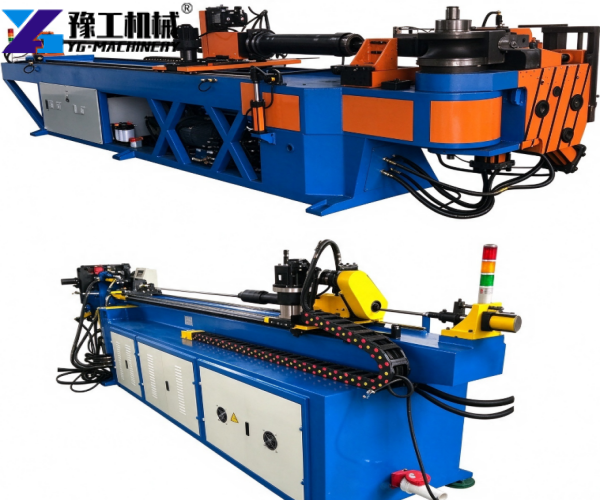
Exhaust pipes, furniture frames, and mechanical tube assemblies require accurate bends and consistent part dimensions. A CNC tube bending machine uses programmed feeding, tube rotation, and hydraulic bending to form metal tubes for production. YG Machinery supplies equipment for iron, stainless steel, copper, aluminum, and square tube processing.
For manufacturers producing custom tube bending parts, machine capacity and tooling selection matter from the start. Tube diameter, wall thickness, material grade, and bend radius determine which parts fit listed machine capacity. CNC control coordinates each bending movement, supporting repeatable positioning during batch production.
CNC Tube Bending Machine Specifications
| Function | Parameters |
| Maximum Bending Capacity Iron (S=40kgf/mm2 ) | 51 x3.0mm |
| The maximum elbow outer diameter when reciprocating feeding | 48 mm |
| Copper tube, aluminum tube( S=25kgf/mm2 ) | 51 |
| Round tube/stainless steel( S=60kgf/mm2 ) | 43 x3.0mm |
| Square iron pipe( S=40kgf/mm2 ) | 48 x2.5mm |
| Iron rod ( S=40kgf/mm2 ) | 40mm |
| Bending radius range | 35~200mm |
| Bending Radius Range/Square Tube | 35~200mm |
| Bending Angle Range | 190° |
| The maximum effective distance through the heart | 2100mm |
| Maximum feeding length | 2700mm |
| Bending (D.O.B.) Speed | 35 deg/sec |
| Feeding (D.B.B.) Speed | 180 deg/sec |
| Rotating tube (P.O.B.) speed | 120deg/sec |
| Hydraulic system motor | 5.5kw |
| Total power | 7.25kw |
| Greatest pressure | 120 kg/cm2 |
| Preset pressure | 90 kg/cm2 |
| Fuel tank capacity | 120L |
| Equipment length x width x height | 3500 X1000X880 |
| Equipment weight | 1350kg |
Automatic Pipe Bending Machine with CNC Control
An automatic pipe bending machine coordinates tube feeding, rotation, and bending through programmed movements. CNC control stores bending sequences, so production does not rely on manual positioning at every bend.
The program controls:
- Tube feed length
- Rotation around tube axis
- Bending angle
- Sequence of bends
- Position of each bend along tube length
For a component with several bends, correct feed distance and rotation keep each bend in its intended position. The part drawing should show bend angles and orientation, especially when a component turns across different planes.
During batch production, saved programs reduce repeated setup work between identical parts. Consistent positioning also supports repeatability, while tooling condition and material variation still affect finished dimensions.
CNC Tube Bending Machine Working Process
- Load tube stock: Set material and length within machine capacity.
- Enter program: Input feed distance, rotation, bend angle, and bending sequence.
- Position tube: Feed and rotate tube to the required bending point.
- Apply hydraulic bending: Form tube around selected tooling.
- Inspect part: Check bend angles, overall dimensions, and connection positions against the component drawing.
For repeat production, keep part drawings and bending programs aligned. Changes to tube length, bend radius, or orientation require corresponding program adjustments.
CNC Tube Bending Machine Features for Metal Fabrication
Hydraulic Bending System
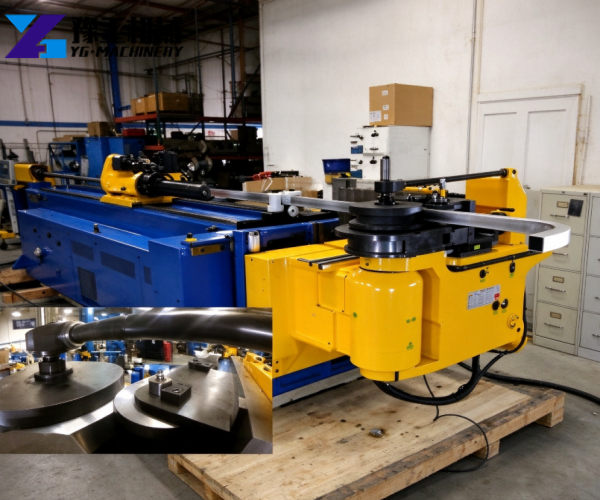
A 5.5kW motor powers the hydraulic system. Maximum pressure reaches 120kg/cm², with preset pressure at 90kg/cm². Total machine power is 7.25kW.
Stable hydraulic control supports consistent bending conditions across production runs. This gives fabricators a controlled basis for repeating programmed bends rather than relying on manual force adjustment. Actual part consistency also depends on material, tooling, and setup.
Feeding and Tube Rotation
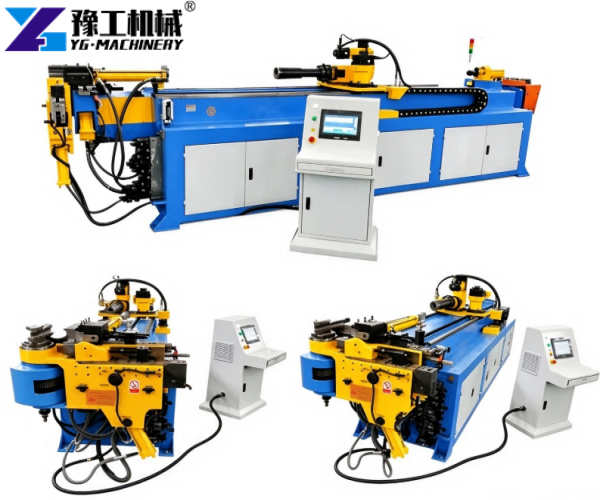
Listed feeding speed reaches 180°/sec, bending speed reaches 35°/sec, and tube rotation speed reaches 120°/sec.
These movements position tube stock for programmed bends. For parts with several bending points, feed distance and rotation must follow the drawing to keep connection positions aligned.
Programmed positioning reduces repeated manual alignment during batch production. This is particularly useful when a job includes identical tube sections with several bending points.
Machine Size and Installation
Machine dimensions measure 3500 × 1000 × 880mm, with listed weight of 1350kg. Maximum feeding length reaches 2700mm.
Allow space for tube loading, finished-part removal, and tooling changes. Long tube stock also requires sufficient working space around the machine.
CNC Tube Bending Machine Applications
Automotive Exhaust Pipes and Tube Components
Exhaust fabrication involves curved pipes, connecting sections, and support components. A bend outside its specified position can affect connection alignment during assembly.
Component drawings should show centerline dimensions, bend angles, and connection locations. Material grade and wall thickness also affect forming, particularly when the part uses a tight radius.
For repeat exhaust components, consistent positioning supports assembly fit across production batches.
Furniture Frames and Metal Supports
Chair frames, table legs, display racks, and shelving use bent tube sections to create their required shape. Consistent bend positions keep frame components aligned during welding and assembly.
For furniture production, specify tube diameter, wall thickness, overall length, and bend orientation. Connection points and end positions also matter when several sections form one frame.
A saved bending program supports repeat production of matching frame components and reduces repeated manual positioning.
Mechanical Tube Assemblies
Machine frames, equipment supports, and hydraulic tube assemblies often require tubes to pass around installed components. Connection positions and surrounding space determine the shape of each section.
Include bend locations, connection points, and required clearance in the component drawing. For replacement parts, add original dimensions and mounting orientation to avoid fitting problems.
How to Select an Automatic Pipe Bending Machine
| Production Requirement | What to Check |
| Tube material | Match material strength with listed capacity |
| Tube diameter and wall thickness | Check both against machine specifications |
| Bend radius | Compare required radius with listed range |
| Bend sequence | Include feed length and bending order |
| Tube orientation | Mark rotation direction and reference position |
| Connection points | Show holes, joints, and end locations |
| Tube stock length | Compare material length with feeding capacity |
FAQ
What tube diameter can this machine bend?
Listed capacity includes iron tube at 51 × 3.0mm, stainless steel round tube at 43 × 3.0mm, and square iron tube at 48 × 2.5mm. Copper and aluminum tube capacity reaches 51mm. Match material strength and wall thickness with corresponding specifications before selecting tube stock.
Can it bend stainless steel tube?
Yes. Listed stainless steel capacity reaches 43 × 3.0mm at material strength of 60kgf/mm². Actual suitability depends on tube grade, wall thickness, required radius, and mandrel configuration. Tight radii may need extra tooling assessment. Send the part drawing to review tooling requirements before production.
Can it process square tube?
The specification lists square iron tube capacity at 48 × 2.5mm, with bending radius range of 35–200mm. Square tube requires tooling that matches its section and bend radius. Tight bends, thick walls, and visible corner requirements need particular attention during tooling selection.
CNC Tube Bending Machine for Production Requirements
YG Machinery supplies CNC tube bending equipment for exhaust fabrication, furniture frames, mechanical tube assemblies, and custom tube bending parts.
For OEM tube bending and repeat production, send your part drawing and production requirements to YG Machinery. Our engineers will review machine capacity, bending sequence, and tooling requirements for your application.