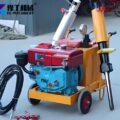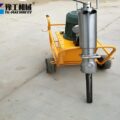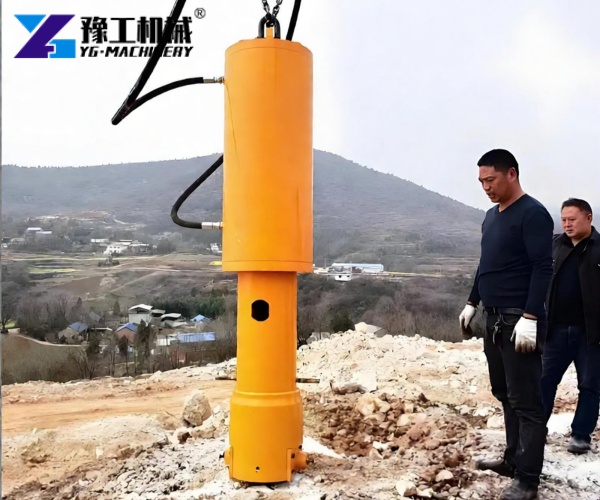
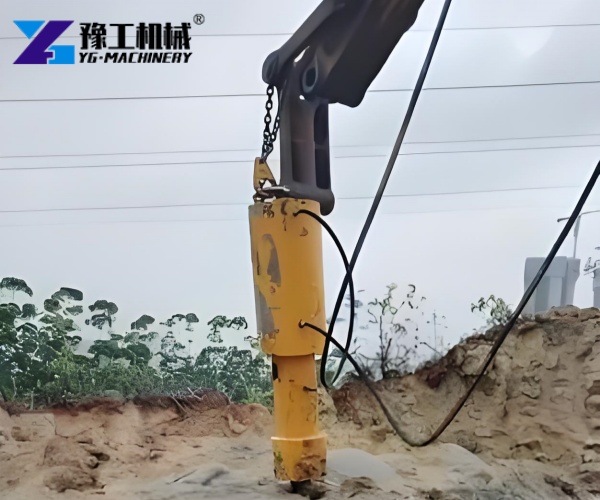
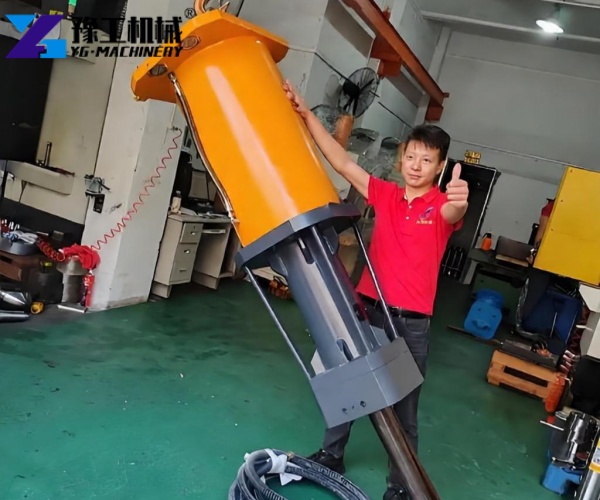
A hydraulic rock splitting machine is a non-explosive rock breaking tool that uses hydraulic pressure to split rock and concrete. This rock splitter machine inserts a wedge into a pre-drilled hole and expands it outward with tremendous force. The rock cracks along the desired direction without vibration, noise, or flying debris. For quarrying, mining, tunnel construction, and building demolition, this hydraulic stone splitter provides a safe, controlled alternative to blasting.
YG Machinery offers hydraulic rock splitters in YG-250, YG-350, and YG-450 models. Splitting force ranges from 800 to 1000 tons. Splitting time is 10-15 seconds per cycle.
Typical specifications include:
- 800-1000T splitting force
- 10-15 second splitting time
- 250-450mm wedge length
- 42-55mm drilling diameter
- 500-900mm drilling depth
- Diesel or electric power options
Technical Parameters of Hydraulic Rock Splitting Machine
| Specification | YG-250 | YG-350 | YG-450 |
| Wedge length | 250mm | 350mm | 450mm |
| Splitter length | 1000mm | 1100mm | 1200mm |
| Wedge weight | 30kg | 36kg | 43kg |
| Piston stroke | 90/220mm | 90/220mm | 90/220mm |
| Drilling depth | >500mm | >700mm | >900mm |
| Drilling diameter | 42mm | 50mm | 55mm |
| Crack width | 10-20mm | 10-20mm | 10-20mm |
| Splitting time | 10-15s | 10-15s | 10-15s |
| Splitting force | 800T | 900T | 1000T |
All models include a diesel power pack (Changchai 6HP or 8HP) and hydraulic power unit with pressure adjustable from 10-60MPa.
Working Principle of Rock Splitter Machine
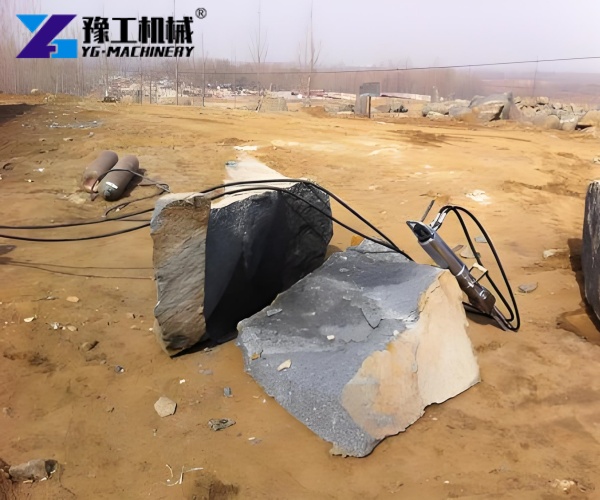
The rock splitter machine operates on the wedge principle. Rock and concrete have high compressive strength but low tensile strength. The splitter exploits this weakness:
1: Drill holes
- Drill holes in the rock or concrete surface
- Drilling diameter must match the splitter size
- Depth should be 200-250mm deeper than wedge insertion length
2: Insert the splitter
- Insert the splitter head into the drilled hole
- Align wedge direction with the desired cracking line
3: Hydraulic pressure
- High-pressure oil from the pump station pushes the piston
- The piston drives the middle wedge forward between two side wedges
4: Wedge expansion
- Side wedges expand outward against the hole walls
- Force exceeds the rock’s tensile strength
5: Rock splitting
- Rock cracks along the predetermined direction
- Splitting takes 10-15 seconds
6: Retraction
- Piston retracts, wedges close
- Splitter removed and moved to the next hole
The process is repeated in sequence. Multiple holes split large rock masses into smaller, manageable pieces.
Key Features of Hydraulic Rock Splitter
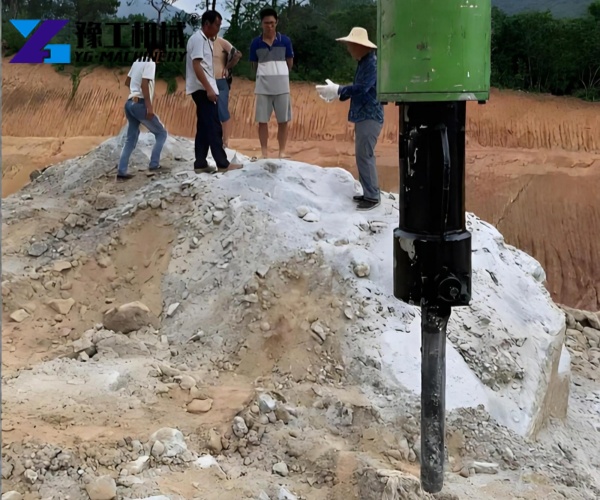
1.Non-explosive operation
- No blasting required
- No permits needed
- Safe for urban areas and near sensitive structures
2.No vibration
- Works statically
- No vibration to surrounding structures
- Safe next to buildings and precision equipment
3.No noise
- Low noise operation
- Suitable for residential areas and indoor work
- No noise complaints
4.No flying debris
- No flying rocks or fragments
- Safe for workers and passersby
- No safety barriers required
5.Huge splitting force
- 800 to 1000 tons of force
- Splits hardest rocks: granite, basalt, limestone
6.Fast splitting
- 10-15 seconds per cycle
- Continuous operation without interruption
- High efficiency for large projects
7.Precise control
- Splitting direction can be predetermined
- Controlled splitting prevents overbreak
- Accurate removal of targeted sections
8.Durable construction
- Wedges made of forged and heat-treated steel
- High wear resistance and flexibility
- Special grease reduces friction, extends service life
9.Versatile use
- Vertically, horizontally, or at any angle
- Works indoors, outdoors, and underwater
Blasting vs Hydraulic Rock Splitter
| Comparison | Blasting | Hydraulic Rock Splitter |
| Permits required | Yes | No |
| Safety measures | Complex, expensive | Simple |
| Vibration | High | None |
| Noise | Very loud | Low |
| Flying debris | Yes | None |
| Precision | Low | High |
| Can be used in cities | No | Yes |
| Underwater use | Difficult | Yes |
| Cost per split | High | Low |
What this means for your business:
Blasting requires permits, safety zones, and protective measures. A hydraulic rock splitter eliminates these costs. Work starts immediately. No permits. No safety zones. Projects finish faster and cost less.
Power Options for Hydraulic Rock Splitter
| Feature | Electric Pump | Diesel Pump |
| Power source | Grid electricity | Diesel fuel |
| Best for | Factories, tunnels, urban sites | Remote mines, outdoor projects |
| Noise level | Low | Moderate |
| Emissions | Zero | Exhaust fumes |
| Operating cost | Lower | Higher |
| Mobility | Limited by cable | Fully mobile |
Electric pump:
- Suitable for indoor work, tunnels, sites with stable power
- Zero emissions, low noise
Diesel pump:
- Suitable for outdoor projects, remote mining, sites without power
- Fully self-contained, works anywhere
YG offers both power options. Choose the one that fits your job site.
Multi-Gun Configuration for Rock Splitter Machine
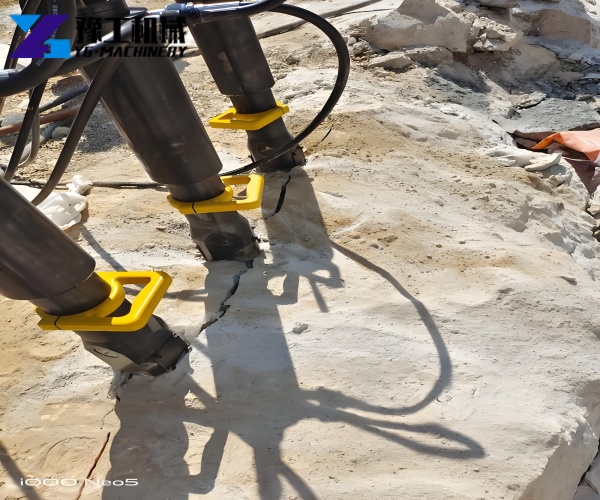
One pump station can drive multiple splitting guns simultaneously, increasing production speed significantly.
| Configuration | Number of guns | Best for |
| Basic | 2-3 guns | Small projects, emergency work |
| Standard | 4-5 guns | Most quarry and construction projects |
| High-efficiency | 6 guns | Large quarry, high-volume production |
How it works:
- Multiple guns inserted into a row of drilled holes
- Hydraulic pressure distributed evenly to all guns
- All guns split simultaneously
- A single row of holes produces a clean, straight crack
Multi-gun configuration increases daily output by 3-5 times compared to single-gun operation.
Applications of Hydraulic Stone Splitter
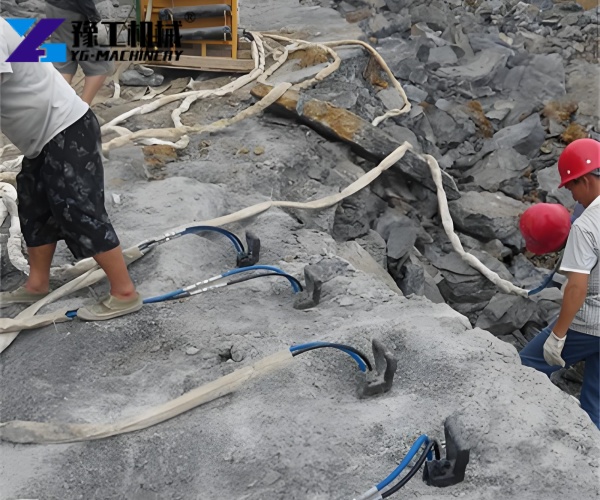
Quarrying and mining
- Extraction of large stone blocks (granite, marble, limestone)
- Secondary disintegration of large ores
- Removal of large waste rock
Tunnel construction
- Tunnel excavation in hard rock
- Subway tunnel excavation
- Underground pipeline tunnel excavation
Building demolition
- Demolition of concrete and reinforced concrete
- Demolition of old buildings, bridges, and piers
- Removal of old foundations and ground slabs
Foundation excavation
- Removal of hard rock in foundation pits
- Rock treatment for building foundations
- Road and highway widening
Chemical and smelting industry
- Overhaul of smelting furnaces
- Removal of refractory bricks in various kilns
- Crushing of carbon blocks
Emergency rescue
- Earthquake and landslide removal
- Mine disaster rescue
- Traffic accident clearance
How to Choose the Right Rock Splitter Machine
| Your rock type | Recommended model | Why |
| Soft rock, small project | YG-250 | 250mm wedge, 800T force |
| Medium hard rock | YG-350 | 350mm wedge, 900T force |
| Hard rock (granite, basalt) | YG-450 | 450mm wedge, 1000T force |
| Large diameter holes | YG-450 | 55mm drilling diameter |
| Small diameter holes | YG-250 | 42mm drilling diameter |
Selection tips:
- Harder rock = larger wedge length + higher splitting force
- Deeper drilling = longer wedge required
- Larger rock blocks = more splitting force needed
- High-volume production = YG-450 with multi-gun configuration
Still not sure? Tell us your rock type, hardness, and project size. We will recommend the right hydraulic rock splitting machine for you.
Customer Case
Case – Australia: Granite Quarry Expansion
Customer: Granite quarry operator in Western Australia
Rock type: Hard granite
Challenge: Blasting cracked the stone, reducing commercial value. 40% of stone was damaged and unusable. Manual splitting was too slow.
Before: 80 cubic meters of usable stone per day. 40% stone damage rate. Inconsistent block quality.
Solution: YG hydraulic rock splitter with 6-gun configuration. Guns split simultaneously. Crack followed drilling line precisely. No stone damage.
After: 400 cubic meters of usable stone per day. Stone breakage reduced from 40% to less than 5%. Block quality improved significantly.
Result: Production increased by 400%. Stone waste reduced to almost zero. Machine paid for itself in 3 months.
Quarry manager: “The hydraulic rock splitter changed our operation. We now produce clean, high-quality stone blocks every day. No more wasted material from blasting damage.”