At a quarry in Nairobi, Kenya, stone crushing, loading, unloading, and stockpiling generate dust. In addition, truck movement adds more dust around the working areas. The quarry runs for about 8 hours a day and previously used manual water hoses for dust control. The Dust Suppression Cannon was later introduced to reach the distant dust sources.
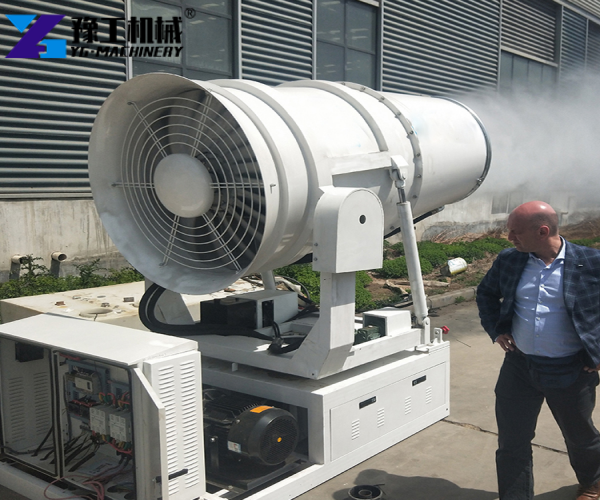
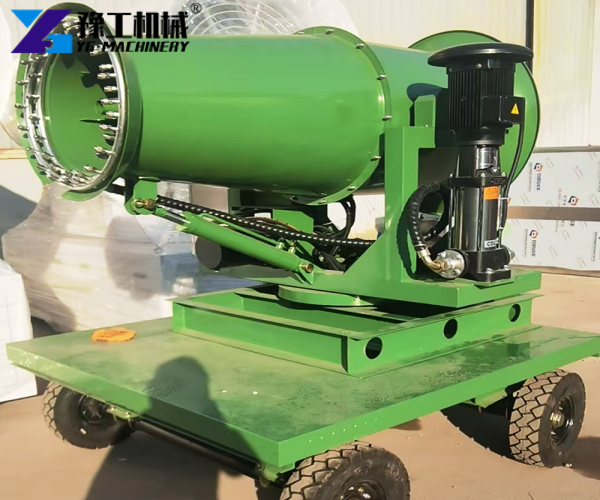
The main dust sources are the stone loading area and the finished stone stockpile, about 30–35 m apart. For this reason, the customer selected the YG-40 Dust Suppression Cannon because it reaches 40 m. It has 16 nozzles, 360° horizontal rotation, and −10° to 55° vertical adjustment. The unit also uses a 4 kW fan motor and 2.5 kW water pump motor, with 6.5 kW total power. Its water consumption is 50 L/min at full flow, and the tank holds 480 L.
YG Machinery also offers YG-20, YG-30, and YG-60. Their spraying distances are 20 m, 30 m, and 60 m. As a result, customers can select a model according to the distance to the dust source and the required coverage.
Dust Suppression Cannon Technical Parameters
| Parameter | YG-20 | YG-30 | YG-40 | YG-60 |
| Spraying distance | 20 m | 30 m | 40 m | 60 m |
| Power supply | 380V/50Hz 3-phase | 380V/50Hz 3-phase | 380V/50Hz 3-phase | 380V/50Hz 3-phase |
| Total power | 4.5 kW | 4.5 kW | 6.5 kW | 18.5 kW |
| Fan motor | 3 kW | 3 kW | 4 kW | 11 kW |
| Water pump motor | 1.5 kW | 1.5 kW | 2.5 kW | 7.5 kW |
| Nozzles | 8 pcs. | 10 pcs. | 16 pcs. | 22 pcs. |
| Water tank | 460 L | 460 L | 480 L | 800 L |
| Water consumption | 16.7 L/min | 25 L/min | 50 L/min | 125 L/min |
| Tank runtime at full flow | Approx. 27.6 min | Approx. 18.4 min | Approx. 9.6 min | Approx. 6.4 min |
| Horizontal rotation | 360° | 360° | 360° | 360° |
| Vertical adjustment | −10° to 55° | −10° to 55° | −10° to 55° | −10° to 55° |
| Weight | 200 kg | 250 kg | 300 kg | 350 kg |
Dust Control Problems at a Kenyan Quarry

Before installation, workers used water hoses near the crushing and loading areas. During busy periods, two workers moved and directed the hoses. Although this method worked for nearby areas, workers had to move the hoses whenever the dust source changed.
Meanwhile, the 30–35 m distance between the loading area and stockpile made the task more difficult. Wind direction also changed during the working day. Therefore, the quarry needed one unit that could reach both areas from a fixed position.
Dust Suppression Cannon Selection and Parameters

The customer chose the YG-40 because its 40 m spraying distance covered the required range. YG Machinery positioned the unit between the two main dust sources. This arrangement allowed the operator to turn the spray toward either area without moving the machine.
The YG-40 provides 360° horizontal rotation and −10° to 55° vertical adjustment. When the working point changed, the operator could adjust the spray direction from the same position. This was useful for both truck loading and stockpiling.
The quarry uses a 380V/50Hz three-phase power supply. At the same time, the water pump takes water from the site’s available water system and sends it to the 16 nozzles. The fan then carries the mist toward the selected dust source.
How the Misting Cannon Was Used
The YG-40 stays in one installation position during normal operation. Instead of moving the machine, the operator changes its direction according to the production activity.
- During loading and unloading: The spray is directed toward the active loading point.
- During stockpiling: The cannon is turned toward the finished stone stockpile.
- During truck movement: The spray direction is changed when trucks create dust in another area.
- When wind direction changes: The horizontal direction and vertical angle can be adjusted.
With 360° horizontal rotation, one machine can serve both main dust areas. The fan carries the mist over the required distance, reducing the need for workers to drag a long water hose between the two locations.
The quarry uses the cannon during dust-producing periods within its 8-hour daily schedule. However, it does not run at full flow for the entire shift. Actual water use depends on operating time and site conditions.
Dust Suppression Cannon Results After Installation

After installation, the Dust Suppression Cannon served the two main dust points from a fixed position. The required 30–35 m coverage was within its 40 m spraying range.
The main changes at the quarry include:
- One machine covers the two main dust areas.
- Manual hose movement is reduced.
- Workers no longer need to move the hose to the distant loading area.
- The spray direction can change during truck and stockpile operations.
- Visible dust around active areas decreases during spraying.
In daily operation, the crew spends less time moving hoses between dust sources. When the active working area changes, the operator can redirect the mist from the same installation position.
The quarry did not use a dedicated PM10 monitoring system for this project. Therefore, the result is based on normal operating observations rather than a measured percentage reduction. Wind speed, material moisture, particle size, and work intensity can also affect dust control.
Customer Feedback
A site supervisor said:
“We do not need to drag the hose to the loading area anymore. We can turn the cannon toward the area that needs it.”
According to the supervisor, the main change was easier daily operation. Before installation, workers moved the hose between the dust sources. Now, they can keep the cannon in position and change its spray direction instead.
YG Machinery Dust Control Equipment

YG Machinery offers dust suppression equipment with spraying distances of 20 m, 30 m, 40 m, and 60 m. Each model has different fan power, pump power, nozzle quantity, tank capacity, and water consumption.
For quarry applications, model selection depends on the distance to the dust source, working area, power supply, water availability, and operating schedule. Customers can provide site photos, dust source locations, installation position, power supply, and water source information.
Based on these details, YG Machinery can check the required spraying distance and match the fan, pump, nozzles, and water consumption to the site.