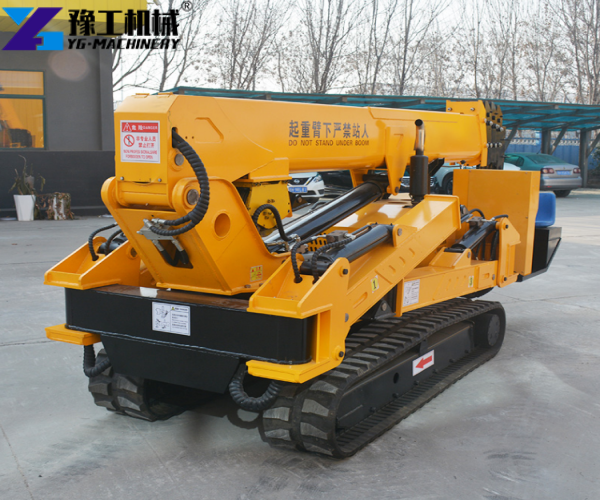
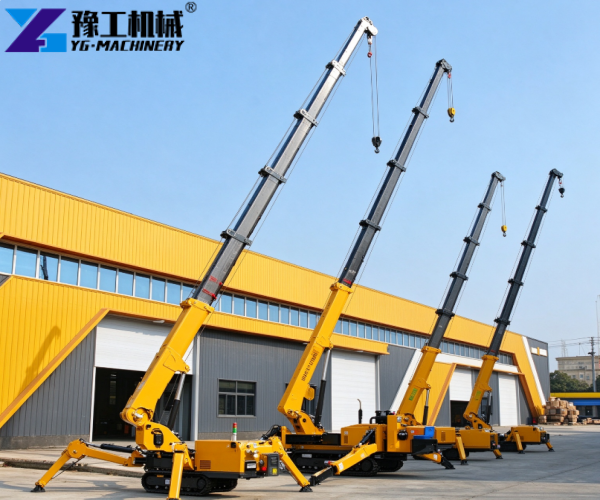
The name mini spider crane comes from its four outriggers, which extend like spider legs. Japanese manufacturers developed these machines in the 1990s to address lifting challenges in crowded urban areas and buildings with limited access. Their compact crawler design allows them to enter spaces that larger cranes cannot reach. Today, they serve indoor construction and installation projects. A 3-ton model can measure just 0.8 m wide and weigh about 2.7 tons, making it a practical option for sites with narrow entrances.
Mini Spider Crane Specifications
| Parameter | YG-3T | YG-5T | YG-8T |
| Maximum operating radius | 8.83 m × 0.2 t | 14 m × 0.5 t | 16.5 m × 0.5 t |
| Maximum ground lift | 9.2 m | 16.8 m | 18 m |
| Hook rising speed | 0–8 m/min (4 ropes) | 12 m/min (4 ropes) | 12 m/min (4 ropes) |
| Wire rope specifications | φ8 mm × 45 m | φ11 mm × 80 m | φ11 mm × 80 m |
| Telescopic arm form | 5-section boom, U-shaped structure | 5-section boom, U-shaped structure | 5-section boom, U-shaped structure |
| Telescopic arm length / time | 3.1–9.2 m / 20 sec | 4.7–16.5 m / 54 sec | 4.7–16.5 m / 54 sec |
| Boom angle / time | 0–78° / 13 sec | 0–78° / 13 sec | 0–78° / 13 sec |
| Rotation angle / speed | 0–360° (continuous) / 60 sec | 0–360° (continuous) / 38 sec | 0–360° (continuous) / 38 sec |
| Overall size | 2.98 × 0.8 × 1.5 m | 5 × 1.5 × 1.9 m | 5 × 1.6 × 2.18 m |
| Total weight | 2,700 kg | 6,200 kg | 7,200 kg |
Why a mini crawler crane Fits Tight Spaces
A mini crawler crane travels on tracks rather than wheels. Its crawler chassis distributes the machine’s weight across a larger contact area, which can reduce ground pressure. This design suits selected indoor floors and outdoor sites with firm or soft ground, subject to ground-bearing capacity.
YG models offer four structural features:
- Five-section U-shaped boom. The U-shaped section combines structural strength with a compact design. The boom extends to reach different working positions.
- 360° continuous rotation. The upper structure turns through a full circle, allowing the operator to position loads without repeatedly moving the chassis.
- Folding outriggers. The outriggers extend to stabilize the crane during lifting and fold inward to reduce the machine’s width during transport.
- Wireless remote control. The operator can stand where the load and lifting path remain visible, making precise positioning easier.
The hydraulic spider crane system controls the boom, outriggers, and other working movements. Smooth hydraulic operation allows the operator to position loads in confined areas.
Typical Spider Crane Applications
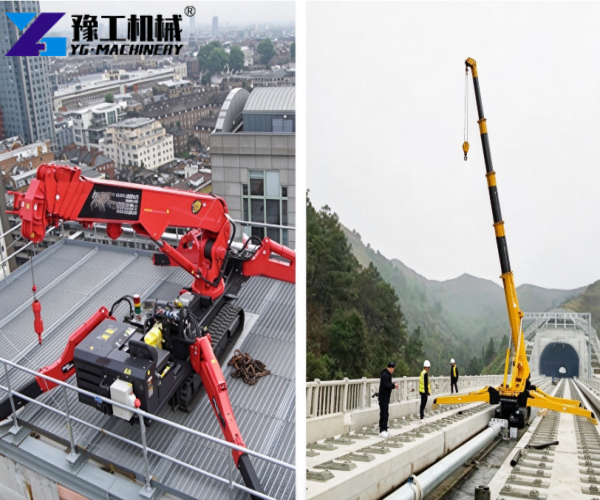
Compact dimensions and flexible boom movement make these cranes useful across several industries. Common applications include:
- Indoor lifting: Installing machinery, moving equipment, and replacing machine tools inside factories.
- Glass curtain walls: Positioning large glass panels with compatible vacuum lifting equipment.
- Steel structure work: Raising steel beams, purlins, and connection components in restricted spaces.
- Landscaping: Moving large trees, placing decorative stones, and handling heavy landscape materials.
- Municipal maintenance: Installing pipes, electrical cabinets, and other equipment along narrow streets.
Before selecting a model, determine the heaviest load and its position relative to the crane. The spider crane lifting capacity decreases as the working radius increases. The load chart must also account for the boom configuration and operating conditions.
What Affects the Mini Spider Crane Price
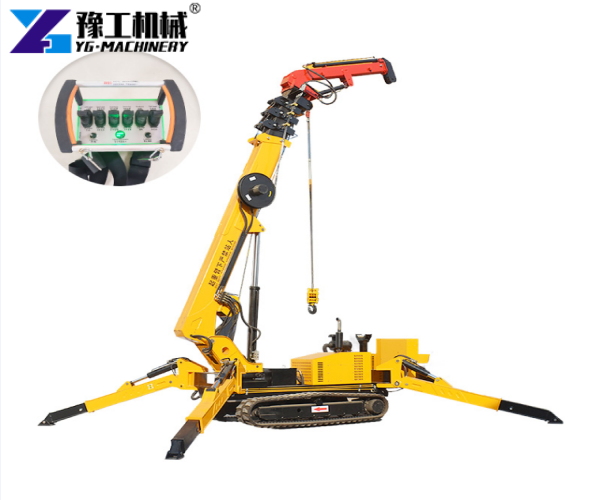
- Capacity and boom length. An 8-ton model generally requires more structural material and a larger hydraulic system than a 3-ton model.
- Power type. Diesel engines suit many outdoor projects. Electric motors can reduce exhaust emissions in indoor work areas. A dual-power configuration usually costs more.
- Attachments. Glass vacuum lifters, man baskets, and jibs add to the purchase cost. Each attachment must match the crane’s permitted working configuration.
- Certification and shipping. Export documentation, destination-country standards, packaging, and sea freight all affect the final cost.
At the same rated capacity, differences in power systems, attachments, and export arrangements can create significant price gaps.
How to Choose a spider crane manufacturer
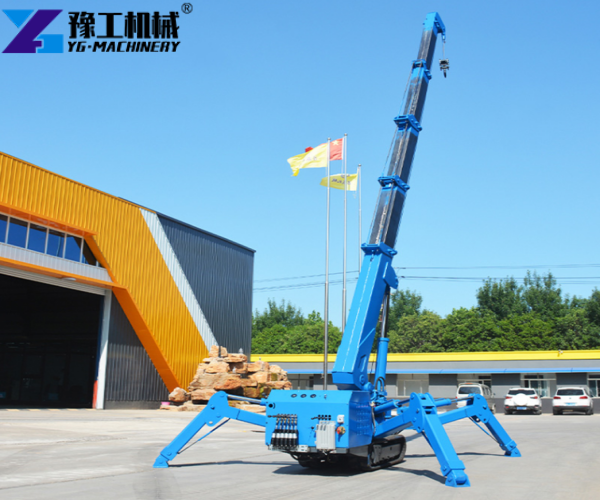
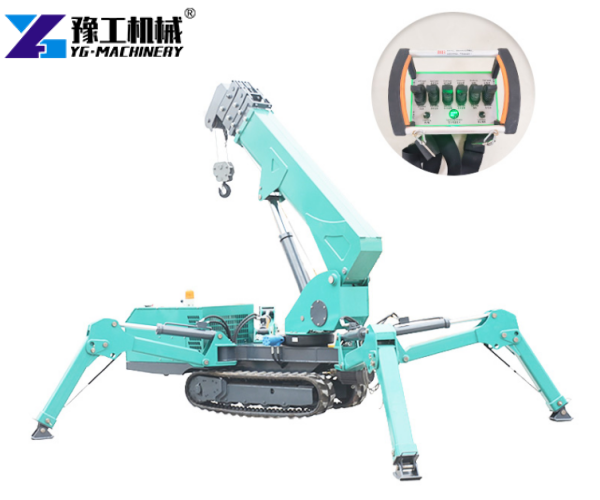
When evaluating a spider crane manufacturer, focus on verifiable production and service information.
Factory facilities:Review the production workshop, assembly process, and factory inspection records. These details show how the supplier manages manufacturing and quality control.
Certificates: Request the documents required for your destination market. Verify certificate numbers and issuing organizations where applicable.
Spare parts availability:Ask about replacement hydraulic components, wire ropes, and other service parts. Their availability can affect maintenance schedules.
Export experience:Request information about previous deliveries, installation conditions, and after-sales arrangements for similar projects.
YG owns its factory and has more than 20 years of experience in construction machinery. The company has exported equipment to many countries and completed more than 20,000 projects. Each machine undergoes factory inspection before shipment. YG Machinery also offers mini concrete pumps, glass installation robots, hydraulic scissor lift platforms, water well drilling rigs. These machines often work alongside a spider crane on different stages of the same project.
FAQ
What type of maintenance does a spider crane require?
A: Routine maintenance includes inspecting hydraulic hoses, wire ropes, tracks, and outriggers. Operators should also follow the manufacturer’s lubrication schedule and keep safety devices in working order.
Can a spider crane work on sloping ground?
Ground slope affects crane stability. The machine must operate within the manufacturer’s permitted limits, with the outriggers deployed as specified. Steep or uneven surfaces may require site preparation before lifting begins.
How many operators are needed to run a spider crane?
The number depends on the project and local safety regulations. One trained operator may control the crane, while a designated signal person can assist with load positioning when visibility or site conditions require it.
What documents are normally supplied with an exported spider crane?
Export documentation may include the commercial invoice, packing list, shipping documents, operation manual, and applicable conformity documents. The exact requirements depend on the destination country and purchase agreement.
Can a spider crane be used for outdoor projects in cold weather?
Yes, if the machine’s operating temperature range and hydraulic system suit the conditions. Cold weather may affect hydraulic oil, battery performance, and starting procedures, so the manufacturer should confirm the required configuration.